
Alexis Wiley didn’t just stumble into food sovereignty work; she planted herself in it with intention, vision, and a deep commitment to community healing. As the founder of Seeds of Liberation, a Philadelphia-based organization centered on communal learning and empowerment, Wiley has carved out space for Black and Indigenous people to reconnect with land, history, and collective liberation. Through educational programming focused on African diasporic history, food systems, and land-based practices, Seeds of Liberation is growing Community consciousness in Philadelphia.
Wiley’s food justice journey began during her junior year at Drexel University in 2020, which was marked by pandemic panic and glaring inequalities. She started working at Sankofa Community Farm, a powerhouse farm of Bartram’s Garden known for its work in cultural foodways, youth empowerment, and community food access. The timing, while chaotic, was revealing.

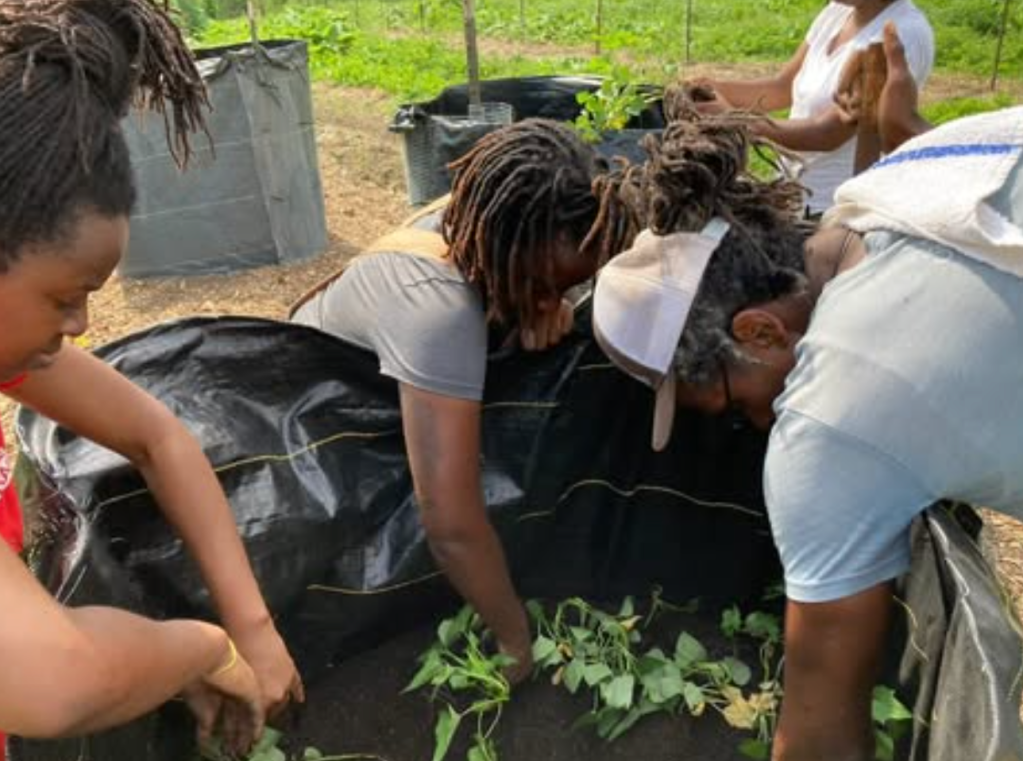
Sankofa team planting sweet potatoes in 2023. Wiley/Holmberg
“It was an interesting time to start working in food sovereignty,” Wiley recalls. “People’s access to food was barely holding on. And once things started to fall apart during the pandemic, folks—especially low-income Black families—were left without consistent access to healthy, culturally relevant meals. That was really eye-opening.”
This crisis shaped Wiley’s ongoing commitment. At Sankofa, she organized volunteer and community garden programs serving between 40 and 60 families annually. Her role deepened her understanding of food apartheid and affirmed that, for many Black communities, food insecurity is historical and systemic. That realization inspired the founding of Seeds of Liberation, which Wiley describes as an answer to a need she felt deeply: “I wanted to create more space for long-term, slower-paced food sovereignty education. I wanted neighbors to understand that this isn’t new—it’s true to us.”
African Diaspora Techniques
At Seeds of Liberation, that truth is honored by embracing what and how they grow. Specializing in African diaspora crops, they cultivate foods indigenous to Africa or adopted into diasporic foodways due to displacement. Think okra, rice, black-eyed peas, sorghum, or collard greens and sweet potatoes, adopted out of necessity when African greens weren’t accessible in North America.
The growing techniques themselves also come from African agricultural traditions. Wiley and her team practice natural, no-till farming with methods like soil bed mounding, which retains water and prevents erosion. They also practice companion planting, which is rooted in many Indigenous cultures but adapted here to reflect African crop relationships. These methods conserve resources and also honor ancestral knowledge.
Her Message to College Students
Wiley believes college is the perfect time to get involved in food justice work for personal well-being and collective impact. “Philadelphia is a college city. When students get involved, they aren’t just helping themselves; they support their neighbors,” Wiley says. “It’s a chance to be politically engaged in a real, tangible way. And when you start connecting the dots between food, climate change, incarceration, and poverty, you will see how everything is tied together.”
Support the Movement
Wiley encourages people to participate in grassroots efforts across the city to support Seeds of Liberation. Groups like Sankofa Community Farm, West Philly Peace Park, and Reentry Community Farm are doing vital on-the-ground work. Supporting these projects, volunteering, and sharing resources helps sustain this growing ecosystem of liberation.
Wiley’s work is rooted in care for the land, community, and futures we can build together. At its core, Seeds of Liberation is about reclaiming agency, rebuilding trust, and restoring relationships with the earth and each other.
As she says, “What if our best could be better because we knew more about how to care for ourselves and each other?”

 Edible Autonomy
Leave a comment